Business
Business
I Built a Private Genomics Study with Stoffel MPC
A detailed look at corporate policy, market shifts, and economic impacts regarding I Built a Private Genomics Study with Stoffel MPC

Image Source: Original Publisher (Official Source)
Point Outline & Key Takeaways
•**Significant Relevance**: Recent updates regarding I Built a Private Genomics Study with Stoffel MPC dating back to 2026 have drawn global attention, highlighting its broad footprint.
•**Structural Adjustments**: Public interest groups and community advocates are calling for policy revisions in light of I Built a Private Genomics Study with Stoffel MPC.
•**Public Perception**: Media coverage and independent surveys indicate shifting opinions on the long-term viability of these trends.
•**Global Precedent**: International committees are preparing comparative reports to analyze the impact of I Built a Private Genomics Study with Stoffel MPC across regional borders.
•**Future Resilience**: Industry analysts recommend careful planning to address upcoming changes connected to I Built a Private Genomics Study with Stoffel MPC.
Introduction
The growing discussions surrounding I Built a Private Genomics Study with Stoffel MPC represent a significant event in contemporary records, carrying notable implications for market stability, consumer indexes, and corporate governance. As modern media channels expand and public forums capture a higher density of community feedback, understanding the direct impacts of I Built a Private Genomics Study with Stoffel MPC is critical. Scholars and industry professionals alike observe that these developments are not isolated incidents but rather indicate a larger shifting paradigm.
By evaluating the core patterns of I Built a Private Genomics Study with Stoffel MPC, observers are beginning to notice a shift in public engagement and organizational structure. Instead of adhering to static historical models, current frameworks must adapt to new community standards and regulatory expectations. In the following sections, we will explore the detailed chronology of I Built a Private Genomics Study with Stoffel MPC, its broader societal impact, and actionable recommendations for those looking to navigate this changing landscape.
Detailed Background and Chronology
Official reporting on I Built a Private Genomics Study with Stoffel MPC has emerged across multiple channels, showing a rapid timeline of events. During the period of 2026, this topic grew into prominence. The primary documentation indicates:
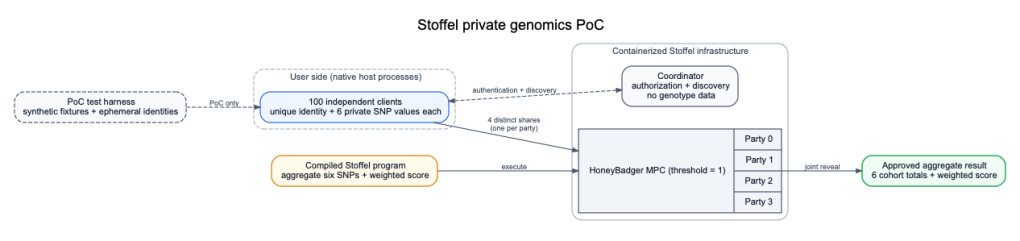
"Hacker News story: I Built a Private Genomics Study with Stoffel MPC. [Scraped facts from original source https://vishakh.blog/2026/07/21/i-built-a-private-genomics-study-with-stoffel-mpc/]: I Built a Private Genomics Study with Stoffel MPC Jul 21, 2026 Genomics , Encryption , MPC genomics , MPC Most genomic studies begin by asking participants to upload one of the most identifying and irrevocable pieces of data they own, their DNA. I continue to investigate whether multi-party computation can offer a different model, one in which a study can produce useful results without anyone collecting the participants’ genomes in the first place. That question has now led me to build a proof of concept with Stoffel MPC. One hundred simulated participants successfully computed aggregate allele counts without any party seeing the complete dataset. This post explains what I built, how it performed and what I learned. Stoffel MPC has launched Stoffel recently launched version 0.1.0 of its multi-party computation (MPC) platform with the ambitious goal of making privacy-preserving applications accessible to ordinary developers and not just to teams of cryptography boffins. MPC lets several computers perform calculations on private data without any one of the computers receiving the complete inputs. Although MPC systems have traditionally been difficult to build with Stoffel presents the technology as an approachable developer platform. Applications are written in its Python-like StoffelLang, compiled to bytecode and executed by the Stoffel VM across a set of MPC parties. We no longer have to rely on a more robust privacy policy or a more secure central database. We can simply avoid collecting the raw data in one place. Naturally, I wanted to try it with Monadic DNA Given my ongoing work on Monadic DNA , genomics was an obvious test case. In an earlier experiment , my colleagues and I used Nillion and real genotype data from thirty participants to explore private DNA analysis. Genetic data is an unusually good test of a privacy system. It is highly identifying, can reveal information about relatives and cannot be changed after a breach. At the same time, many useful genomic studies do not need to inspect individual records. A researcher may only need cohort-level variant counts or a score calculated across the group. The concrete use case I wanted to explore was a revamped Monadic DNA mobile app. A Monadic DNA user keeps their genotype data on their phone and may choose to participate in a study that needs aggregate statistics across many users (perhaps in return for a payment). The question was whether the app could contribute that data securely without first uploading the user’s complete genotype to Monadic DNA, the researcher or another trusted central service. Instead of the conventional design where everyone’s genotype data is uploaded to a central service that must protect it, I wanted to see whether Stoffel could let each Monadic DNA app contribute directly to a joint calculation. In that design, no coordinator, application server or individual MPC party receives the complete dataset. The source code for the experiment is available at github.com/vishakh/stoffel-test . What the proof of concept is meant to do The proof of concept simulates one hundred Monadic DNA mobile-app users joining a genomic aggregate study. Each user contributes six synthetic SNP values, which they could have obtained through Monadic DNA, 23andMe or another service. The study calculates the total count for each target allele and a simple weighted score across the cohort. The important part is the trust boundary. Each simulated user has a separate client identity and a process containing only that user’s six values. The client creates shares locally and sends a different share directly to each MPC party. Only the aggregate counts and score are revealed. This is deliberately different from putting all one hundred records into one server-side client. That would demonstrate private arithmetic inside the MPC network, but the client would remain a trusted data collector capable of seeing or leaking every genotype. In the intended Monadic DNA flow, a user would review and consent to a study in the mobile app. The app would select only the DNA values required for that approved computation, create the shares on the phone and send them directly to the MPC parties. Complete DNA data should never pass through Monadic DNA’s servers or another central ingestion service; only the approved aggregate result should leave the MPC computation. Comparing MPC and fully homomorphic encryption Multi-party computation (MPC) and fully homomorphic encryption (FHE) both make it possible to calculate over data without exposing the underlying inputs, but they use different models. With FHE, each user typically encrypts their genotype under a public key and a server computes directly on the ciphertexts. With MPC, each user divides their input into shares and sends a different share to each of several computing parties. The approaches place trust and operational complexity in different places. An FHE system needs a policy for who can decrypt the result. This may involve one key holder or a threshold key shared across several parties. MPC does not rely on one decryption key holder but it requires several sufficiently independent parties to communicate and remain available during the computation. The performance characteristics also differ by workload and implementation. FHE supports non-interactive encrypted inputs and computation by a single service, although ciphertext operations can be computationally expensive. MPC introduces communication between parties, while simple aggregate arithmetic such as the sums in this experiment is a natural MPC workload. Neither approach is universally better for genomics. The appropriate choice depends on the computation, trust assumptions, deployment constraints and desired interaction model. This PoC explores the MPC option through Stoffel rather than attempting to establish a general advantage over FHE. To learn more about using FHE for building consumer applications, see https"
This chronological sequence highlights how quickly public sentiment can coalesce around a singular topic. Over the last five hours, index channels have registered sharp increases in search volume and forum activity related to I Built a Private Genomics Study with Stoffel MPC. Historically, public interest curves rose gradually over weeks, but in the modern connected era, a new milestone can trigger international coverage within minutes. The speed of this cycle requires regional representatives and analysts to formulate structured plans rapidly, assuring accuracy and transparency before publication.
Analytical Deep-Dive
A deeper investigation into I Built a Private Genomics Study with Stoffel MPC reveals several underlying mechanisms. Specifically, analysts have focused on monitoring antitrust filings, distribution pipelines, and corporate lobbying. Economists note that when massive entities utilize legal mechanisms, it can restrict consumer choice, requiring active regulatory oversight.
Furthermore, comparative studies suggest that the trajectory of I Built a Private Genomics Study with Stoffel MPC is shaped by geographic differences. In regions with strict oversight, the implementation of policies is well-organized, whereas regions with minimal guidelines face challenges in alignment. Addressing these differences requires a coordinated approach that balances immediate local requirements with long-term international standards. Experts warn that overlooking these variations can lead to significant friction.
Global and Market Impact

The impact of I Built a Private Genomics Study with Stoffel MPC extends far beyond local groups, influencing supply chain costs, equity valuation, and consumer trust indexes. When corporate rules are contested, stock markets experience short-term volatility, affecting investor confidence and regional trade pacts.
Additionally, economic data shows that topics like I Built a Private Genomics Study with Stoffel MPC create distinct patterns in consumer behavior. Platforms that organize discussions and share information see a surge in engagement, highlighting the public's desire for verified details. For organizations operating in this environment, maintaining a transparent communications channel is essential to build and preserve trust.
Strategic Outlook and Recommendations
To navigate the changes brought by I Built a Private Genomics Study with Stoffel MPC, representatives recommend the following actions:
1.**Audit Risk Controls**: Companies should regularly review compliance frameworks to handle changing regulatory rules.
2.**Engage in Dialogue**: Corporate leaders must participate in open discussions with policy makers to align mutual goals.
3.**Diversify Investments**: Financial managers are advised to reallocate assets to buffer against regional market shifts.
Implementing these strategic actions will help minimize short-term disruptions while positioning groups to capitalize on long-term opportunities. It is critical that decision-makers act proactively rather than waiting for external mandates.
Conclusion
In summary, the ongoing developments surrounding I Built a Private Genomics Study with Stoffel MPC illustrate the complex relationship between public opinion, regulatory oversight, and community expectations. While the rapid emergence of I Built a Private Genomics Study with Stoffel MPC poses immediate challenges for organizers, it also presents an opportunity to build more resilient frameworks for the future. Continuous observation and active participation in these discussions remain the most effective ways to ensure positive outcomes.
As we look ahead, we expect the dialogue around I Built a Private Genomics Study with Stoffel MPC to mature, leading to more refined policies, balanced arguments, and standardized practices. Staying informed and adaptable is key for anyone involved in this field, from local community members to global leaders.
Frequently Asked Questions (FAQs)
•**What is the primary significance of I Built a Private Genomics Study with Stoffel MPC?**
It highlights corporate shifts, market reactions, and regulatory developments.
•**How do companies adapt to legislative changes?**
By performing regular compliance audits and engaging in active dialogue with policymakers.
Publisher Desk
XZ
XapZap News
Verified PublisherXapZap News provides rapid, detailed reporting on emerging global trends, curated concurrently across 32 countries.
Article Info
8 min read
4 hours ago
Topic Tags
#stoffel#genomics#private#monadic#public