Business
Business
Most Americans Say "Not in My Backyard" to AI Data Centers
A detailed look at corporate policy, market shifts, and economic impacts regarding Most Americans Say "Not in My Backyard" to AI Data Centers

Image Source: Original Publisher (Official Source)
Point Outline & Key Takeaways
•**Significant Relevance**: Recent updates regarding Most Americans Say "Not in My Backyard" to AI Data Centers dating back to 2026 have drawn global attention, highlighting its broad footprint.
•**Structural Adjustments**: Public interest groups and community advocates are calling for policy revisions in light of Most Americans Say "Not in My Backyard" to AI Data Centers.
•**Public Perception**: Media coverage and independent surveys indicate shifting opinions on the long-term viability of these trends.
•**Global Precedent**: International committees are preparing comparative reports to analyze the impact of Most Americans Say "Not in My Backyard" to AI Data Centers across regional borders.
•**Future Resilience**: Industry analysts recommend careful planning to address upcoming changes connected to Most Americans Say "Not in My Backyard" to AI Data Centers.
Introduction
The growing discussions surrounding Most Americans Say "Not in My Backyard" to AI Data Centers represent a significant event in contemporary records, carrying notable implications for market stability, consumer indexes, and corporate governance. As modern media channels expand and public forums capture a higher density of community feedback, understanding the direct impacts of Most Americans Say "Not in My Backyard" to AI Data Centers is critical. Scholars and industry professionals alike observe that these developments are not isolated incidents but rather indicate a larger shifting paradigm.
By evaluating the core patterns of Most Americans Say "Not in My Backyard" to AI Data Centers, observers are beginning to notice a shift in public engagement and organizational structure. Instead of adhering to static historical models, current frameworks must adapt to new community standards and regulatory expectations. In the following sections, we will explore the detailed chronology of Most Americans Say "Not in My Backyard" to AI Data Centers, its broader societal impact, and actionable recommendations for those looking to navigate this changing landscape.
Detailed Background and Chronology
Official reporting on Most Americans Say "Not in My Backyard" to AI Data Centers has emerged across multiple channels, showing a rapid timeline of events. During the period of 2026, this topic grew into prominence. The primary documentation indicates:
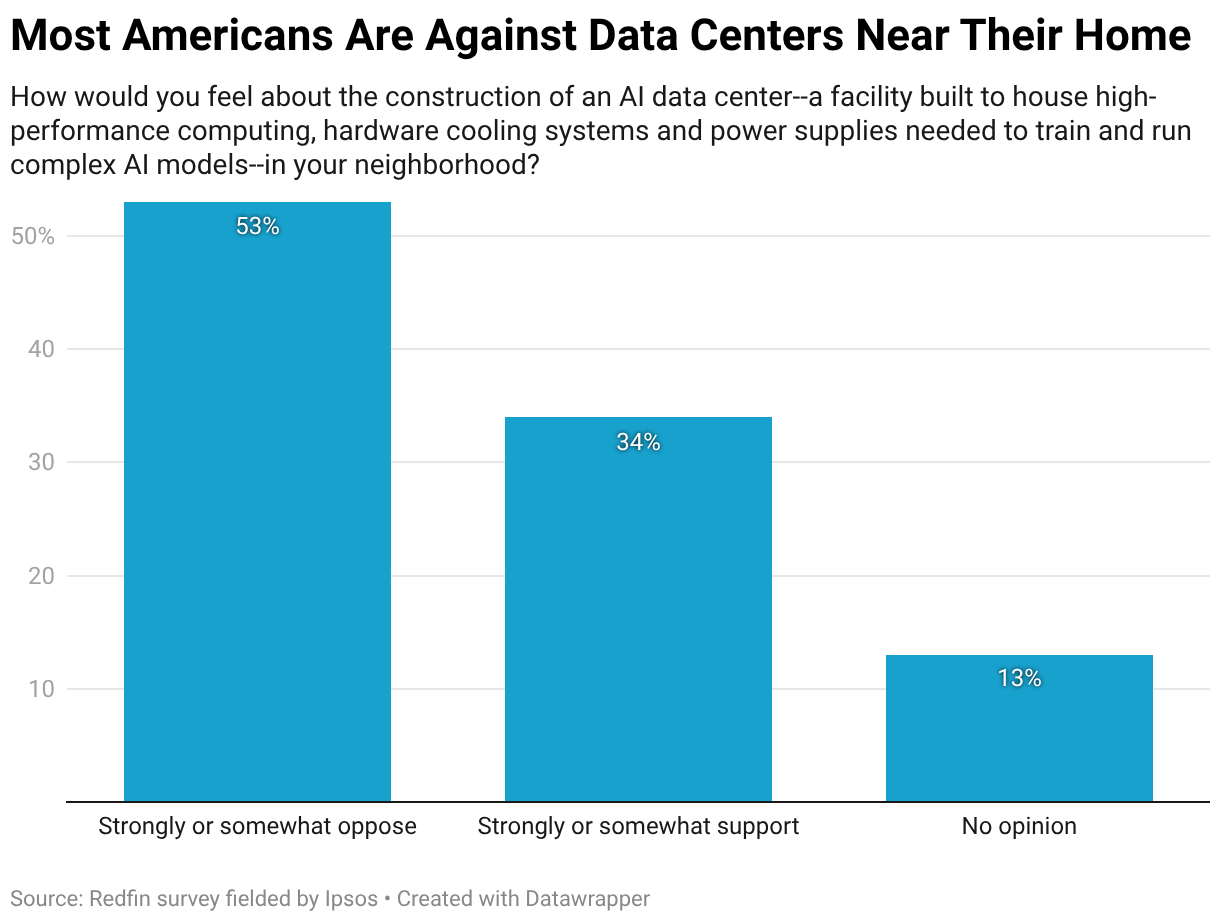
"Hacker News story: Most Americans Say "Not in My Backyard" to AI Data Centers. [Scraped facts from original source https://www.redfin.com/news/ai-data-centers-opposition-education-benefit/]: Skip to content Most Americans Say “Not in My Backyard” to AI Data Centers Published on July 22nd, 2026 by Dana Anderson 53% of U.S. residents oppose building a data center in their area, while 34% support it, per a recent Redfin survey. U.S. residents are more likely to oppose data centers in their neighborhood than any other type of building; for instance, 39% oppose a new apartment complex nearby. AI data centers are controversial because they strain electricity and water resources, and can disrupt communities with noise and large structures. But a Redfin analysis found that AI data centers have benefits: In northern Virginia, taxes on data center equipment are likely contributing to a surge in education spending. Meanwhile, individual homeowners’ property-tax rates are declining. Data center hubs Loudoun County, VA and Prince William County, VA have seen education spending nearly double over the last decade. More than half (53%) of U.S. residents oppose the construction of an AI data center in their neighborhood, according to a recent Redfin survey. Roughly one-third (34%) support it. This is according to a Redfin-commissioned survey conducted by Ipsos in May 2026, fielded to 4,000 U.S. residents. The results for this combined group of survey respondents have a credibility interval of +/-1.9 percentage points. This report focuses on a question about how respondents feel about building certain types of properties in their neighborhoods. The building types are listed in the chart in the final section of this report. Respondents could select “strongly support,” “somewhat support,” “strongly oppose,” “somewhat oppose,” or “no opinion.” For this report, we combined the strongly/somewhat responses. AI data centers are controversial largely because they strain electricity and water resources , which can push up energy costs and spark environmental concerns , per various news sources. They can also disrupt communities with noise and large, industrial-looking structures. One example of opposition is New York’s recent statewide ban on building large data centers. For some people, AI data centers also represent broader fears about AI: Nearly three in five (58%) of U.S. residents believe that advances in AI will eliminate jobs and make it harder to afford homes, according to the same survey. “A buyer recently asked me, unprompted, to make sure there wasn’t a data center planned near a home she was considering,” said Matt Ferris , a Redfin Premier agent in northern Virginia. “I have another client who recently moved into a community in Gainesville, in Prince William County, where there are several data centers. About a year after they moved in, they said they probably would have chosen a different location had they known there were so many data centers nearby. People are concerned about noise, increased traffic, heavy water and electricity use, and how a large industrial building might change the feel of their neighborhood. Right or wrong, the perception is that data centers will change neighborhoods in a negative way.” Broken down by age, older generations are more likely than younger generations to oppose data centers in their area. Roughly two-thirds (65%) of baby boomers and 60% of Gen Xers oppose the construction of an AI data center in their neighborhood, compared with 42% of Gen Zers and 43% of millennials. Additionally, Americans are more likely to oppose data centers in their neighborhood than any other type of building we asked about. More than half of U.S. residents oppose construction of a data center near their home, while 39% oppose a new apartment complex and 32% oppose a mixed-use development. Forty-eight percent oppose converting single-family homes into smaller dwellings to increase supply in their area. AI Data Centers Are Helping Fund Virginia Schools While the majority of Americans don’t want to live near AI data centers, the structures can provide educational benefits to communities. The boom in AI data centers in northern Virginia is helping fund public schools through a surge in tax revenue. A Redfin analysis of county financial records found that Virginia’s two largest data-center hubs — Loudoun County and Prince William County — have seen far faster growth in education spending than neighboring counties over the last 15 years. Both counties collect substantial taxes on computer equipment housed inside data centers; Loudoun’s financial reports identify computer equipment in data centers as the largest source of personal property tax revenue, which is paid by the companies responsible for them. Loudoun County is home to 176 data centers, more than twice the number of any other U.S. county. Neighboring Prince William County ranks third nationally, with 77 facilities. Santa Clara County, CA is second, with 83 data centers; we didn’t include Santa Clara County in this analysis of education spending because data centers aren’t a major source of revenue for that area. This analysis found that AI data centers are driving a tax windfall in Loudoun and Prince William counties. Personal property tax revenue, which are levies imposed on physical assets — like AI data centers — per resident has increased nearly 639% in Loudoun County over the last 15 years, and it rose 349% in Prince William County. That’s compared with 91% growth in neighboring Fairfax County, which has the fifth-most data centers in the U.S. but far fewer than Prince William County or Loudon County. Increased tax revenue from data centers has contributed to a surge in education spending in Prince William and Loudoun counties. Prince William County increased education spending per resident by 82% to $1,589 over the last 15 years. Loudoun County increased it by 77% to $2,955 per resident. For comparison, Fairfax County increased education spending per resident by 49% to $2,234 over that period. Stafford County, VA, where there is just one operational data center, increased it by 29% to $1,024. Local officials f"
This chronological sequence highlights how quickly public sentiment can coalesce around a singular topic. Over the last five hours, index channels have registered sharp increases in search volume and forum activity related to Most Americans Say "Not in My Backyard" to AI Data Centers. Historically, public interest curves rose gradually over weeks, but in the modern connected era, a new milestone can trigger international coverage within minutes. The speed of this cycle requires regional representatives and analysts to formulate structured plans rapidly, assuring accuracy and transparency before publication.
Analytical Deep-Dive
A deeper investigation into Most Americans Say "Not in My Backyard" to AI Data Centers reveals several underlying mechanisms. Specifically, analysts have focused on monitoring antitrust filings, distribution pipelines, and corporate lobbying. Economists note that when massive entities utilize legal mechanisms, it can restrict consumer choice, requiring active regulatory oversight.
Furthermore, comparative studies suggest that the trajectory of Most Americans Say "Not in My Backyard" to AI Data Centers is shaped by geographic differences. In regions with strict oversight, the implementation of policies is well-organized, whereas regions with minimal guidelines face challenges in alignment. Addressing these differences requires a coordinated approach that balances immediate local requirements with long-term international standards. Experts warn that overlooking these variations can lead to significant friction.
Global and Market Impact

The impact of Most Americans Say "Not in My Backyard" to AI Data Centers extends far beyond local groups, influencing supply chain costs, equity valuation, and consumer trust indexes. When corporate rules are contested, stock markets experience short-term volatility, affecting investor confidence and regional trade pacts.
Additionally, economic data shows that topics like Most Americans Say "Not in My Backyard" to AI Data Centers create distinct patterns in consumer behavior. Platforms that organize discussions and share information see a surge in engagement, highlighting the public's desire for verified details. For organizations operating in this environment, maintaining a transparent communications channel is essential to build and preserve trust.
Strategic Outlook and Recommendations
To navigate the changes brought by Most Americans Say "Not in My Backyard" to AI Data Centers, representatives recommend the following actions:
1.**Audit Risk Controls**: Companies should regularly review compliance frameworks to handle changing regulatory rules.
2.**Engage in Dialogue**: Corporate leaders must participate in open discussions with policy makers to align mutual goals.
3.**Diversify Investments**: Financial managers are advised to reallocate assets to buffer against regional market shifts.
Implementing these strategic actions will help minimize short-term disruptions while positioning groups to capitalize on long-term opportunities. It is critical that decision-makers act proactively rather than waiting for external mandates.
Conclusion
In summary, the ongoing developments surrounding Most Americans Say "Not in My Backyard" to AI Data Centers illustrate the complex relationship between public opinion, regulatory oversight, and community expectations. While the rapid emergence of Most Americans Say "Not in My Backyard" to AI Data Centers poses immediate challenges for organizers, it also presents an opportunity to build more resilient frameworks for the future. Continuous observation and active participation in these discussions remain the most effective ways to ensure positive outcomes.
As we look ahead, we expect the dialogue around Most Americans Say "Not in My Backyard" to AI Data Centers to mature, leading to more refined policies, balanced arguments, and standardized practices. Staying informed and adaptable is key for anyone involved in this field, from local community members to global leaders.
Frequently Asked Questions (FAQs)
•**What is the primary significance of Most Americans Say "Not in My Backyard" to AI Data Centers?**
It highlights corporate shifts, market reactions, and regulatory developments.
•**How do companies adapt to legislative changes?**
By performing regular compliance audits and engaging in active dialogue with policymakers.
Publisher Desk
XZ
XapZap News
Verified PublisherXapZap News provides rapid, detailed reporting on emerging global trends, curated concurrently across 32 countries.
Article Info
8 min read
4 hours ago
Topic Tags
#centers#americans#backyard#county#oppose